This article is a long time in the making. In 2017, just before the end of summer, a young man at our church returned unexpectedly from what would have been a lucrative summer working on a fishing boat in Alaska. Things did not pan out for that adventure, and I wanted to help him out, so I offered to hire him as an independent contractor to help me with some work around the homestead.
What started off as some simple land management quickly took a serious turn. I realized I had a hard worker on my hands, so I bumped up his pay (twice) and cooked up a really big project, one that I had been wanting to tackle but had only given modest consideration. That project was to replace the unsafe and not particularly attractive landscape block retaining wall next to the driveway, adjacent to our basement door, with something more functional, attractive, and safe.
Unfortunately, the number of "before" pictures I took were scant. I happened to catch the view from the garage, behind the house here, where you can see the ground slumps off to the left. The wall is there, just outside the left side of the frame, at about floor level from the garage, totaling about 4 feet in height, with no railing. I lived in mortal fear of my kids falling off of this wall and getting a broken something.
In my mind, I envisioned taking this stone wall, which curved in from the back corner of the basement, half a floor below the garage, towards the middle left of the picture you see above, and making a straight, tall wall, with a rail along the top. I was initially undecided on composition and whether there would be stairs, but after getting some quotes for concrete (five figure quotes, I might add) I opted for timber construction.
As with all of my projects, I started off with some SketchUp models. The final design for the railing didn't really come together until the wall was built.
Construction began with demolition. I had my hired help tear down the wall and relocate the block for future use. Then we started digging a trench for a compacted gravel footing. A buddy rented himself and his bobcat to me for an afternoon to help with excavation as we had almost concrete hardness clay to get through, shot through with melon size rocks.
All in all, we wound up moving about 16 yards of material, cutting through the previous layers of grading and gravel that had been dumped to raise the grade after initial construction of the home. This gravel turned out to be very handy as we sifted it through hardware cloth to make as many loads of compacting material to level the first run of sleepers as we needed.
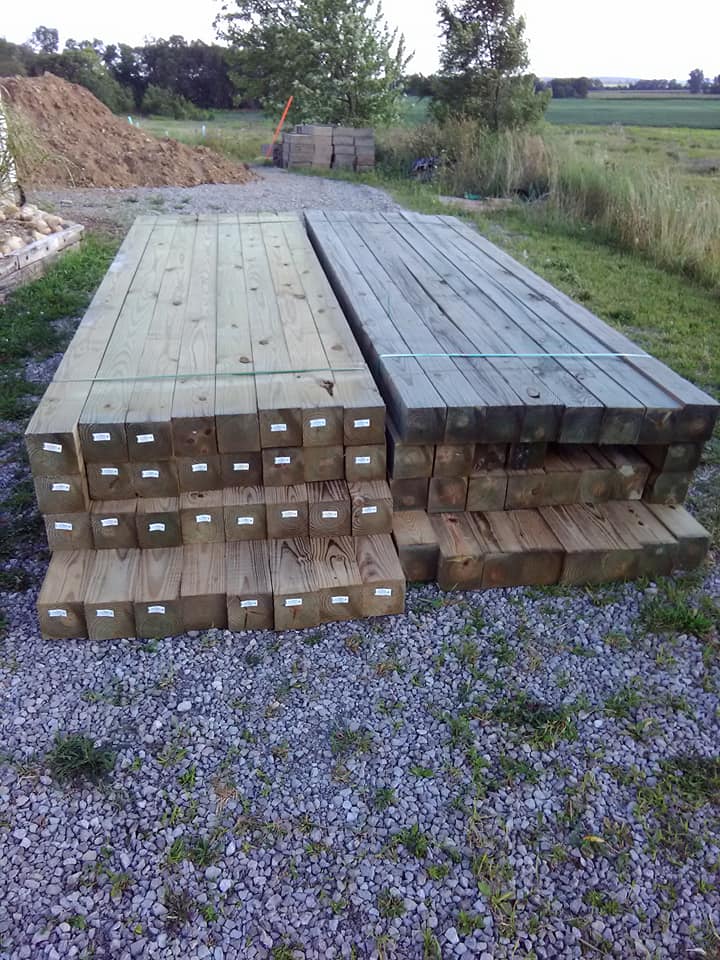
The raw materials took the form of two full bunks of 5.5" x 5.5" x 12' copper arsenic treated timbers. This is the commercial grade pressure treat chemical that everyone loses their minds about. Wet, it's something that can be absorbed through the skin and should be handled minimally and washed off soon. Dry, it's very stable and the amount of arsenic likely to leach into the surrounding soil is not much higher than naturally occurring background levels. I conducted extensive research on this before breaking these bunks apart.
Starting off, we carefully leveled our compacted gravel with a spirit level and tamper. We double checked our first level of sleepers as we put them down. These were anchored into the ground with 24" steel spikes to prevent lateral shifts.
As we began building up the levels, each new level was lag bolted to the preceding one with 1/2" x 8" hot dip galvanized screws. We used a combination of a socket wrench with a pipe extension on it for heavy torquing and an impact driver with a socket adapter for getting the screws started. Each screw was placed in a predrilled pilot hole which included a counter sink pass with a spade bit to allow for the 1.5" galvanized washer that we put between each screw and the wood. This was done to ensure our bolts never pulled through and to provide more grab for snugging down timbers that were not quite true. The project would eventually consume 150 screws and washers of this specification.

As work progressed, we paid attention to routing both the down spout and the curtain drain, each with a final grade that observed a strict down hill flow away from the home's foundation and the rear of the wall. Also pictured below is the first coursing of "T" dead-men built into the wall to keep it from pulling away from the hill under the load of the back fill material and any parked vehicles.
Getting all of the layers up took about 6 weeks. On the days I had my hired help, we could knock out 2 to four layers depending on what other issues arose that required attention.
In order to ensure the back fill material would experience a minimum of settling after we were done, I packed it in behind the wall as construction was in progress. Every three inches went through the process of being scooped into the wheelbarrow from our reserve pile, shown above the wall, carted into place, poured and raked out, and finally tamped down with a 12 lb 8" hand tamper.
As the wall height increased, the length and span of the dead-men was increased as well to afford maximum grip in the increasingly shallow back fill. The top two also had steel T plates added for additional strength. In the middle of the back side of the wall, you can also see a vertical post. This was added to stiffen the wall, as I discovered it had some flex and wiggle to it as it grew taller. I could get it to move about half an inch by kicking it, and the stiffener reduced that considerably. A coat of "FlexSeal" was also applied to the back to help reduce sediment seeping through the cracks of the wall.
With the weather starting to turn towards fall and the major construction done, I got to work sealing the timbers with Cabbot Stain "Austrailan Timber Oil", a modified water based oil product that produces a durable water-resistant covering in one coat. It has weathered two winters considerably well but I might reapply in another two years.
After much deliberation, my wife and I decided on a railing style we both liked and was achievable with my skills. I chose a design that reminded us both of the bars often seen on the upper half of nicer horse stalls. Wanting to keep a farmhouse feel, we felt this was a good compromise for appearance, minimal obstruction of the view from either side, aesthetics and price.
The basic pattern was to lag a 3.5 x 3.5" pre-stained post to the back of the wall every 4 feet and some odd inches, making even divisions as much as possible. Between these the assembly process started with a bottom cord made from pre-stained pressure treated 2 x 4 anchored to the posts with Kerg exterior pocket screws (3"), two to each under side of the 2 x 4. Then the spacing was calculated and penciled onto the top of the board. A plastic fitting was screwed into the center points marked for each spindle. Then the aluminum spindle was tapped onto the fitting.

The top chord is comprised of two pre-stained 2 x 4's screwed together from alternating angles along the top with the same pocket screws. This arrangement hid our fasteners from view. The same calculating and penciling in of center points was conducted on the underside of this top member and the plastic fittings screwed into place. The entire top was then carefully placed, one fitting at a time, onto the spindles and tapped down with a mallet. Finally, more pocket screws were used to tie the top member into the balusters. We topped the railing with synthetic deck board, by Azek. This was an expensive add-on, but I wanted to have as little maintenance to perform on this wall as possible going forward, so my hope is that the material pays for itself in saved time in the future, but it added a $1100 to the project (the steps were also clad in this material, visible on the first step below).

One of the design challenges encountered along the way was that the wall, though carefully assembled, was not absolutely true and plumb. The balusters needed some shimming to get them where we wanted them. Needing a non-compressible, drillable, cutable, weather safe material, I settled on vinyl baseboard for my shim material. This allowed me to cut pieces to length and slide them behind the baluster to as many thicknesses as possible to bring things plumb.
Here's one of the last few shots of the overall view I had taken. It's before the stairway railing and top cap, but gives a sense of the improved appearance behind the house. Much tidier.
As a final touch, I added solar powered foot lights to the steps. The wall they are mounted on faces south so the have enough charge to light up at night except on particularly overcast days.
The final total bill for labor and materials came in around $4,500 for this project. You may notice a few photos up there are block retaining walls on the hill opposite our new wall. That is currently the subject of planning and modeling in SketchUp. I don't have a final plan for that yet, but presently it looks like this.
It features a mirror stairway up to the landing, then an additional flight of stairs up to a new deck, which will cover an outdoor dining area and kitchen. Part of this construction process and demolition will remove quite a bit of dirt immediately adjacent to a poured concrete porch, not shown, at the same grade level as the deck, right around the corner of the house. This presents an engineering challenge that I haven't yet resolved to my satisfaction. Once I do, however, I estimate this next phase of the project will cost about $8,000 to $10,000. These factors combine to put the targeted start sometime in 2020.